


- PRESS RELEASE
January 2026 euro area bank lending survey
3 February 2026
- Banks tightened credit standards for firms, citing higher perceived risks amid lower risk tolerance
- Credit standards eased slightly for housing loans, but tightened further for consumer credit
- Small increase in demand for loans to firms, while demand for housing loans grew moderately
- Trade tensions and related uncertainty added to tighter credit standards and dampened loan demand
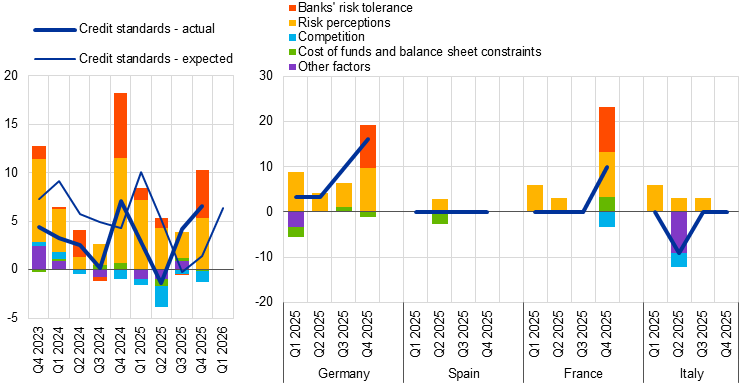
According to the January 2026 bank lending survey (BLS), euro area banks reported an unexpected net tightening of credit standards (banks’ internal guidelines or loan approval criteria) for loans or credit lines to enterprises in the fourth quarter of 2025 (net percentage of banks of 7%; Chart 1). Banks reported a small net easing of credit standards for loans to households for house purchase (net percentage of -2%), whereas credit standards for consumer credit and other lending to households tightened further (net percentage of 6%). For firms, the net tightening in the fourth quarter followed a smaller net tightening of credit standards in the third quarter, surpassing the expectations reported by banks in the previous survey round (1%). Concerns about the outlook for firms and the broader economy, as well as banks’ lower risk tolerance, contributed to tighter credit standards. Banks indicated a small net easing of credit standards for housing loans, which they had not expected, and a further net tightening of credit standards for consumer credit, which was above the expectations they had reported in the prior quarter. For housing loans, competition had an easing impact on credit standards, while risk perceptions had a tightening impact. Banks’ lower risk tolerance and higher risk perceptions were the main drivers of the tightening for consumer credit. For the first quarter of 2026, banks expect a moderate further net tightening of credit standards for firms, a slight tightening for housing loans and a more marked tightening for consumer credit.
Banks’ overall terms and conditions (the actual terms and conditions agreed in loan contracts) tightened for loans to firms and consumer credit, while they eased for housing loans.
Banks reported a net increase in the share of rejected loan applications for firms and consumer credit, while the share remained unchanged, in net terms, for housing loans. The net increase in share was higher than in the previous quarter for firms, but lower for households.
In the fourth quarter of 2025, banks reported a continued small net increase in demand for loans or credit lines to firms (net percentage of 3%; Chart 2). This followed a similar net increase in loan demand in the previous quarter and exceeded the expectations reported by banks in that quarter (0%). Firms’ loan demand was primarily driven by an increase in demand for inventories and working capital and other financing needs, whereas fixed investment continued to make an overall neutral net contribution. Demand for housing loans continued to increase in net terms (net percentage of 9%), albeit more moderately, broadly in line with banks’ expectations in the previous quarter. Improved housing market prospects were the main driver of the increase in housing loan demand, while consumer confidence contributed negatively. Demand for consumer credit and other lending to households declined slightly (net percentage of -2%), following broadly unchanged demand in the third quarter and being somewhat lower than what banks had expected in the previous quarter. Lower consumer confidence dragged consumer credit demand down despite the continuing positive contribution from the level of interest rates. In the first quarter of 2026, banks expect a net increase in loan demand from firms and households.
Banks’ access to retail funding and money markets deteriorated slightly in the fourth quarter of 2025, while it eased for debt securities and securitisations. Over the next three months, banks expect access to funding to remain broadly unchanged, except for a slight easing in debt securities funding.
In response to new regulatory or supervisory actions, banks reported a net increase in their capital and holdings of liquid assets, although they indicated a temporary decline in risk-weighted assets. They also indicated a net tightening impact on credit standards stemming from the above-mentioned actions across all loan categories, with further net tightening expected for 2026.
Banks reported a small net tightening impact of non-performing loan ratios and other credit quality indicators on their credit standards for all loan categories in the fourth quarter of 2025, with risk perceptions and risk aversion being the most prominent factors. In the first quarter of 2026, banks expect a further small tightening impact for loans to firms and for consumer credit, while they expect a broadly neutral impact for housing loans.
Credit standards tightened in construction, wholesale and retail trade, energy-intensive manufacturing and commercial real estate (CRE) in the second half of 2025, with the net tightening being strongest in the manufacturing of motor vehicles. Tightening remained moderate in the overall manufacturing sector, while non-financial services other than CRE saw no or only small net tightening. Banks also reported a net increase in demand for loans in non-financial services other than CRE and no changes or just slight declines in other sectors in the second half of 2025. For the first half of 2026, banks expect either a further net tightening or broadly unchanged credit standards across the main economic sectors. They expect a net increase in loan demand for most sectors except for the manufacturing of motor vehicles, wholesale and retail trade, and CRE.
Based on a new question concerned with the impact of changes in trade policies and related uncertainty, almost half of the BLS banks assessed their exposure as important. Banks reported a tightening impact on credit standards, mostly through a decrease in risk tolerance, and a dampening impact on demand for loans to firms. Banks expect a similar impact for 2026.
The quarterly BLS was developed by the Eurosystem to improve its understanding of bank lending behaviour in the euro area. The results reported in the January 2026 survey relate to changes observed in the fourth quarter of 2025 and changes expected in the first quarter of 2026, unless otherwise indicated. The January 2026 survey round was conducted between 15 December 2025 and 13 January 2026. A total of 153 banks were surveyed in this round, with a response rate of 100%.
Chart 1
Changes in credit standards for loans or credit lines to enterprises, and contributing factors
(net percentages of banks reporting a tightening of credit standards, and contributing factors)
Source: ECB (BLS).
Notes: Net percentages are defined as the difference between the sum of the percentages of banks responding “tightened considerably” and “tightened somewhat” and the sum of the percentages of banks responding “eased somewhat” and “eased considerably”. The net percentages for “Other factors” refer to an average of the further factors which were mentioned by banks as having contributed to changes in credit standards. Data are for the euro area and for the four largest euro area countries.
Chart 2
Changes in demand for loans or credit lines to enterprises, and contributing factors
(net percentages of banks reporting an increase in demand, and contributing factors)

Source: ECB (BLS).
Notes: Net percentages for the questions on demand for loans are defined as the difference between the sum of the percentages of banks responding “increased considerably” and “increased somewhat” and the sum of the percentages of banks responding “decreased somewhat” and “decreased considerably”. The net percentages for “Other factors” refer to an average of the further factors which were mentioned by banks as having contributed to changes in loan demand. Data are for the euro area and for the four largest euro area countries.
For media queries, please contact Benoit Deeg, tel.: +49 (0) 69 134495686.
Notes
- A report on this survey round is available on the ECB’s website, along with a copy of the questionnaire, a glossary of BLS terms and a BLS user guide with information on the BLS series keys.
- The euro area and national data series are available on the ECB’s website via the ECB Data Portal. National results, as published by the respective national central banks, can be obtained via the ECB’s website.
- For more detailed information on the BLS, see Köhler-Ulbrich, P., Dimou, M., Ferrante, L. and Parle, C., “Happy anniversary, BLS – 20 years of the euro area bank lending survey”, Economic Bulletin, Issue 7, ECB, 2023, and Huennekes, F. and Köhler-Ulbrich, P., “What information does the euro area bank lending survey provide on future loan developments?”, Economic Bulletin, Issue 8, ECB, 2022.
Europejski Bank Centralny
Dyrekcja Generalna ds. Komunikacji
- Sonnemannstrasse 20
- 60314 Frankfurt am Main, Niemcy
- +49 69 1344 7455
- media@ecb.europa.eu
Przedruk dozwolony pod warunkiem podania źródła.
Kontakt z mediami