


1 Overview of results
In the bank lending survey (BLS) on the fourth quarter of 2025, euro area banks reported an unexpected net tightening of credit standards for loans or credit lines to firms (net percentage of banks of 7%; see Overview table).[1] Perceived risks to the economic outlook as well as the lower risk tolerance displayed by banks drove this development, signalling a high degree of risk aversion on the part of banks. Across the largest euro area countries, banks in Germany and France reported tighter credit standards for firms, partly but not exclusively related to firms affected by changes in trade policies, while credit standards remained unchanged in Spain and Italy. For the first quarter of 2026, banks expect a further net tightening of credit standards for loans to firms (6%).
Banks reported a small net easing of credit standards for housing loans, whereas credit standards for consumer credit tightened further (net percentages of -2% and 6% respectively). For housing loans, competition had an easing impact on credit standards while risk perceptions had a tightening impact. Banks’ lower risk tolerance and higher risk perceptions were the main drivers of the tightening for consumer credit. Across the largest euro area countries, credit standards for housing loans remained unchanged in Spain and Italy, tightened in Germany and eased in France. The easing of credit standards for housing loans was unexpected, whereas banks had expected a tightening for consumer credit. For the first quarter of 2026, banks expect credit standards to tighten for housing loans (3%) and, more markedly, for consumer credit (9%).
Firms’ demand for loans continued to increase slightly, in net terms, in the fourth quarter of 2025, with heterogeneity across countries, banks and firm sizes (net percentage of 3%). The net increase in loan demand was similar to that for the third quarter (2%). It was mainly driven by an increase in demand for inventories and working capital, debt refinancing/restructuring and mergers and acquisitions (within “other financing needs”), whereas fixed investment made an overall neutral net contribution to loan demand. The general level of interest rates continued to provide slight support to the increase in loan demand, although less than in previous quarters, with the supportive impact concentrated in Italy. Across the largest euro area countries, demand for loans to firms increased in Germany and Italy and decreased in Spain and France. The increase in loan demand was unexpected. For the first quarter of 2026, banks expect a further net increase in loan demand (6%).
Banks reported an additional, albeit more moderate, net increase in demand for housing loans, whereas demand for consumer credit decreased slightly (net percentages of 9% and -2% respectively). Improved housing market prospects were the main driver of the increase in demand for housing loans, while consumer confidence contributed negatively. Developments in interest rates contributed only very slightly to the net increase in demand and were offset by a negative contribution from other financing needs. The net increase in demand was lower than in the previous quarter (28%) but broadly in line with banks’ expectations (8%). Consumer credit demand declined as consumer confidence weakened, despite the positive contribution from the general level of interest rates. The decrease in demand for consumer credit contrasts with previous expectations of a minor increase (2%). For the first quarter of 2026, banks expect a small increase in demand for both housing loans (3%) and consumer credit (2%).
Overall credit terms and conditions tightened for loans to firms and consumer credit, while they eased for housing loans. For firms, it was the first net tightening since the fourth quarter of 2023, driven by lending rates, collateral requirements and other terms and conditions, while margins on average loans continued to narrow. For housing loans, developments in lending rates provided a strong tightening contribution while margins on average loans narrowed. For consumer credit, the tightening was driven by higher rates, higher margins on riskier loans and idiosyncratic factors, while margins on average loans had an easing impact.
Banks reported a net increase in the share of rejected loan applications for large firms, small and medium-sized enterprises (SME) and consumer credit, and an unchanged share for housing loans. The net increase in the share was higher than in the previous quarter for large firms and lower for SMEs, housing loans and consumer credit.
This BLS round contained the following ad hoc questions:
- Euro area banks’ access to retail funding and money markets deteriorated slightly in the fourth quarter of 2025, while it eased for debt securities and securitisations. The deterioration in access to retail funding was due to long-term retail funding, while the improvement in funding through debt securities was driven by medium to long-term securities. Over the next three months, banks expect access to retail and money market funding and to securitisation markets to remain broadly unchanged and to ease slightly for debt securities funding.
- In response to new regulatory or supervisory actions, euro area banks reported a net increase in their capital and holdings of liquid assets, while indicating a temporary decline in risk-weighted assets. Banks also indicated a net tightening impact on credit standards stemming from such actions across all loan categories, with further net tightening expected for 2026.
- Euro area banks reported a small net tightening impact of non-performing loan (NPL) ratios and other credit quality indicators on their credit standards for all loan categories in the fourth quarter of 2025, with risk perceptions and risk aversion being the most prominent factors. In the first quarter of 2026, euro area banks expect a further small tightening impact for loans to firms and for consumer credit, while they expect a broadly neutral impact for housing loans.
- Credit standards tightened in construction, wholesale and retail trade, energy-intensive manufacturing and commercial real estate (CRE) in the second half of 2025, with the net tightening being strongest in the manufacturing of motor vehicles. It remained moderate in the overall manufacturing sector, while non-financial services other than CRE saw no or only small net tightening. Banks also reported a net increase in demand for loans in non-financial services other than CRE and no change or only slight declines in other sectors in the second half of 2025. For the first half of 2026, euro area banks expect either a further net tightening or broadly unchanged credit standards across the main economic sectors. Banks expect a net increase in loan demand for most sectors, the only exceptions being the manufacturing of motor vehicles, wholesale and retail trade, and CRE.
- Based on a new question on the impact of changes in trade policies and related uncertainty, almost half of the BLS banks assessed their exposure as “important”. Banks reported a tightening impact on credit standards, mostly through a decrease in risk tolerance, and a dampening impact on demand for loans to firms. Banks expect a similar impact for 2026.
Overview table
Latest BLS results for the largest euro area countries
(net percentages of banks reporting a tightening of credit standards or an increase in loan demand)
Country | Enterprises | House purchase | Consumer credit | |||||||||||||||
|---|---|---|---|---|---|---|---|---|---|---|---|---|---|---|---|---|---|---|
Credit standards | Demand | Credit standards | Demand | Credit standards | Demand | |||||||||||||
Q3 25 | Q4 25 | Avg | Q3 25 | Q4 25 | Avg | Q3 25 | Q4 25 | Avg | Q3 25 | Q4 25 | Avg | Q3 25 | Q4 25 | Avg | Q3 25 | Q4 25 | Avg | |
Euro area | 4 | 7 | 8 | 2 | 3 | -1 | 0 | -2 | 6 | 28 | 9 | 2 | 5 | 6 | 5 | 1 | -2 | 0 |
Germany | 10 | 16 | 4 | 10 | 6 | 5 | 4 | 11 | 4 | 26 | 4 | 8 | 7 | 11 | 2 | 7 | 0 | 7 |
Spain | 0 | 0 | 9 | 8 | -17 | -6 | 0 | 0 | 13 | 50 | 20 | -8 | 0 | 8 | 10 | 17 | 0 | -6 |
France | 0 | 10 | 6 | -27 | -10 | -5 | 0 | -14 | 2 | 38 | 14 | 3 | 0 | 9 | 0 | -25 | -18 | -3 |
Italy | 0 | 0 | 11 | 9 | 9 | 3 | 0 | 0 | 1 | 9 | 36 | 9 | 8 | 8 | 5 | -8 | 15 | 9 |
Notes: “Avg” refers to historical averages, which are calculated over the period since the beginning of the survey, excluding the most recent round. Owing to the different sample sizes across countries, which broadly reflect the differences in the national shares in lending to the euro area non-financial private sector, the size and volatility of the net percentages cannot be directly compared across countries.
Box 1
General notes
The BLS is addressed to senior loan officers at a representative sample of euro area banks, representing all euro area countries and reflecting the characteristics of their respective national banking structures. The main purpose of the BLS is to enhance the Eurosystem’s knowledge of bank lending conditions in the euro area.[2]
Detailed tables and charts based on the responses provided can be found in Annex 1 for the standard questions and Annex 2 for the ad hoc questions. In addition, BLS time series data are available on the ECB’s website through the ECB Data Portal – see also the notes to charts throughout this report.
Detailed explanations on the BLS questionnaire, the aggregation of banks’ replies to national and euro area BLS results, the BLS indicators and information on the BLS series keys are available on the ECB’s website in the BLS user guide. A copy of the BLS questionnaire with the standard questions and a glossary of BLS terms can also be found on the ECB BLS webpage.
2 Loans to enterprises
2.1 Net tightening of credit standards
Euro area banks reported an unexpected net tightening of credit standards for loans or credit lines to firms in the fourth quarter of 2025 (net percentage of banks of 7%; see Chart 1 and Overview table).[3] This followed the lower net tightening of credit standards for loans to firms in the third quarter of 2025 (4%), surpassing the expectations reported by banks in that quarter (1%). The cumulated net tightening was 19% since the third quarter of 2024 (i.e. since the start of the latest monetary policy easing cycle).[4] Across the largest euro area countries, banks in Germany and France reported tighter credit standards for loans to firms, while credit standards remained unchanged in Spain and Italy. The net tightening for euro area firms was around the historical average since 2003 (8%) but above the historical average since 2014 (3%).[5] It was higher for loans to large firms than for loans to SMEs (net percentages of 6% and 2% respectively; see Chart 2). Across maturities, banks reported a net tightening of credit standards for both short-term and long-term loans (net percentage of 7% for both).
Concerns about the outlook for firms and the broader economy, as well as banks’ lower risk tolerance, led to tighter credit standards (see Chart 1 and Table 1). The net tightening signalled a high degree of risk aversion and a prudent approach to lending by banks. As part of their perceived risks, banks referred to a tightening impact of both the industry-specific and the firm-specific situation (10%) and the general economic outlook (7%). This is also consistent with the net tightening impact of banks’ NPL ratios and other indicators of asset quality on credit standards via perceived risks for banks (see Section 5.3). In addition, higher perceived risks and the lower risk tolerance reported by banks are influenced in part by the impact of changes in trade policies and related uncertainty (see Section 5.5). Banks’ balance sheet situations and competition had a broadly neutral impact on credit standards in the fourth quarter of 2025. Across the largest euro area countries, banks in Germany and France reported higher perceived risks and a lower risk tolerance as the main drivers of the net tightening. Banks in Spain and Italy mentioned no notable impact from any particular factor.
Chart 1
Changes in credit standards applied to the approval of loans or credit lines to enterprises, and contributing factors
(net percentages of banks reporting a tightening of credit standards, and contributing factors)

Notes: “Credit standards - actual” are changes that have occurred, while “Credit standards - expected” are changes anticipated by banks. Net percentages are defined as the difference between the sum of the percentages of banks responding “tightened considerably” and “tightened somewhat” and the sum of the percentages of banks responding “eased somewhat” and “eased considerably”. “Cost of funds and balance sheet constraints” is the simple average of “banks’ capital and the costs related to banks’ capital position”, “access to market financing” and “liquidity position”; “Risk perceptions” is the simple average of “general economic situation and outlook”, “industry or firm-specific situation and outlook/borrower’s creditworthiness” and “risk related to the collateral demanded”. “Competition” is the simple average of “competition from other banks”, “competition from non-banks” and “competition from market financing”. The net percentages for “Other factors” refer to an average of the further factors which were mentioned by banks as having contributed to changes in credit standards. The full set of data underlying this chart can be downloaded via the following ECB Data Portal links: euro area and four largest euro area countries.
Chart 2
Changes in credit standards applied to the approval of loans or credit lines to SMEs and large enterprises, and contributing factors
(net percentages of banks reporting a tightening of credit standards, and contributing factors)

Notes: See the notes to Chart 1. The full set of data underlying this chart can be downloaded via the following ECB Data Portal links: loans to SMEs and loans to large enterprises.
In the first quarter of 2026, euro area banks expect a moderate further net tightening of credit standards for loans to firms (net percentage of 6%). Banks expect that the net tightening of credit standards for loans to large firms will remain stronger than for loans to SMEs (7% and 2% respectively) and that credit standards will tighten more for long-term loans (7%) than for short-term loans (3%). In line with the developments seen in the fourth quarter, banks in Germany and France expect a net tightening while banks in Spain and Italy anticipate unchanged credit standards for firms in the first quarter of 2026.
Table 1
Factors contributing to changes in credit standards for loans or credit lines to enterprises
(net percentages of banks)
Country | Cost of funds and | Pressure from | Perception of risk | Banks’ risk tolerance | ||||
|---|---|---|---|---|---|---|---|---|
Q3 2025 | Q4 2025 | Q3 2025 | Q4 2025 | Q3 2025 | Q4 2025 | Q3 2025 | Q4 2025 | |
Euro area | 0 | 0 | 0 | -1 | 3 | 5 | 0 | 5 |
Germany | 1 | -1 | 0 | 0 | 5 | 10 | 0 | 10 |
Spain | 0 | 0 | 0 | 0 | 0 | 0 | 0 | 0 |
France | 0 | 3 | 0 | -3 | 0 | 10 | 0 | 10 |
Italy | 0 | 0 | 0 | 0 | 3 | 0 | 0 | 0 |
Note: See the notes to Chart 1.
2.2 Terms and conditions tightened
Overall terms and conditions for new loans to enterprises tightened for the first time since the fourth quarter of 2023 (net percentage of 4%; see Chart 3 and Table 2).[6] Banks referred to a net tightening impact from lending rates, consistent with the uptick in euro area risk-free rates towards the end of 2025, as well as stricter collateral requirements and other terms and conditions, such as loan size, maturity and loan covenants, in the fourth quarter of 2025. Margins on average loans continued to have a small easing impact for loans to firms, while margins on riskier loans had a broadly neutral impact on terms and conditions. Across the four largest euro area countries, banks in Germany, Spain and France reported a net tightening of overall terms and conditions, driven by lending rates (in Germany and Spain), loan margins (in Germany), and collateral requirements and other terms and conditions (in France). Banks in Italy indicated a net easing of overall terms and conditions related to lower lending rates. Across firm sizes, euro area banks reported a net tightening of overall terms and conditions for loans both to SMEs and to large firms (5% and 3% respectively; see Chart 4). The tightening impact of lending rates was concentrated on loans to SMEs. This might indicate, together with wider margins on riskier loans to SMEs, that banks have added an additional charge for higher credit risk. For loans to SMEs, the tightening was also due to stricter collateral requirements and other terms and conditions. For loans to large firms, banks referred to broadly unchanged lending rates, and a tightening impact via stricter collateral requirements and other terms and conditions, whereas margins on average loans continued to narrow and margins on riskier loans remained unchanged.
Chart 3
Changes in terms and conditions on loans or credit lines to enterprises
(net percentages of banks reporting a tightening of terms and conditions)

Notes: “Overall terms and conditions” are the actual terms and conditions agreed in the loan contract. “Lending rates” was introduced in April 2024. “Margins” are defined as the spread over relevant market reference rates. “Other terms and conditions” is the simple average of “non-interest rate charges”, “size of the loan or credit line”, “loan covenants” and “maturity”. The net percentages for “Other components” refer to an average of the further terms and conditions components which were mentioned by banks as having contributed to changes in overall terms and conditions. The full set of data underlying this chart can be downloaded via the following ECB Data Portal links: euro area and four largest euro area countries.
Table 2
Changes in terms and conditions on loans or credit lines to enterprises
(net percentages of banks)
Country | Overall terms and conditions | Banks’ lending rates | Banks’ margins on average loans | Banks’ margins on riskier loans | ||||
|---|---|---|---|---|---|---|---|---|
Q3 2025 | Q4 2025 | Q3 2025 | Q4 2025 | Q3 2025 | Q4 2025 | Q3 2025 | Q4 2025 | |
Euro area | 1 | 4 | -1 | 4 | -4 | -2 | 0 | 1 |
Germany | 6 | 6 | 3 | 16 | 6 | 6 | 6 | 13 |
Spain | -8 | 8 | -8 | 8 | -8 | 0 | 0 | 0 |
France | 0 | 10 | 0 | 0 | -9 | -10 | -9 | -10 |
Italy | 0 | -9 | 0 | -9 | 0 | 0 | -9 | 0 |
Note: See the notes to Chart 3.
Higher risk perceptions and lower risk tolerance were the primary drivers behind the overall tightening of terms and conditions for euro area firms (see Table 3). Competition had a small easing effect, mainly among banks in France.
Chart 4
Changes in terms and conditions on loans or credit lines to SMEs and large enterprises
(net percentages of banks reporting a tightening of terms and conditions)

Notes: See the notes to Chart 3. The full set of data underlying this chart can be downloaded via the following ECB Data Portal links: loans to SMEs and loans to large enterprises.
Table 3
Factors contributing to changes in overall terms and conditions for loans or credit lines to enterprises
(net percentages of banks)
Country | Cost of funds and balance sheet constraints | Pressure from competition | Perception of risk | Banks’ risk tolerance | ||||
|---|---|---|---|---|---|---|---|---|
Q3 2025 | Q4 2025 | Q3 2025 | Q4 2025 | Q3 2025 | Q4 2025 | Q3 2025 | Q4 2025 | |
Euro area | -1 | -1 | -3 | -2 | 5 | 6 | 1 | 3 |
Germany | 0 | 2 | -1 | 1 | 3 | 5 | 0 | 3 |
Spain | -8 | 0 | 0 | 0 | 0 | 3 | 0 | 0 |
France | 0 | -3 | -3 | -7 | 6 | 17 | 0 | 10 |
Italy | 0 | -3 | -3 | 0 | 9 | 0 | 0 | 0 |
Notes: The net percentages for these questions relating to contributing factors are defined as the difference between the percentage of banks reporting that the given factor contributed to a tightening and the percentage of banks reporting that it contributed to an easing. “Cost of funds and balance sheet constraints” is the simple average of “banks’ capital and the costs related to banks’ capital positions”, “access to market financing” and “liquidity position”. “Perception of risk” is the simple average of “general economic situation and outlook”, “industry-or-firm-specific situation and outlook/borrower’s creditworthiness” and “risk related to the collateral demanded”. “Pressure from competition” is the simple average of “competition from other banks”, “competition from non-banks” and “competition from market financing”. Aggregate series for “cost of funds and balance sheet constraints”, “perception of risk” and “pressure from competition” were discontinued from the first quarter of 2022, when detailed sub-factors were introduced. The full set of data underlying this chart can be downloaded via the following ECB Data Portal links: euro area and four largest euro area countries.
2.3 Rejection rates increased further
Banks reported a further net increase in the share of rejected loan applications for firms (net percentage of 6%, see Chart 5). The net increase was similar to the previous quarter (5%), and higher for large firms than for SMEs (6% and 2% respectively). This follows previous quarters in which the net increase in the share of loan rejections was higher for loans to SMEs than for large firms. The higher net increase in the share of loan rejections for large firms is consistent with the stronger net tightening of credit standards for loans to large firms than for loans to SMEs in the fourth quarter.
Banks in Germany and France reported a net increase in the share of rejected corporate loan applications in the fourth quarter of 2025. For Germany, the net increase was similar for loans to SMEs and large firms, whereas in France banks reported a net increase in the share of rejected loan applications for large firms but not for SMEs. Banks in Spain and Italy indicated unchanged rejection rates for loans to firms.
Chart 5
Changes in the share of rejected loan applications for enterprises
(net percentages of banks reporting an increase)
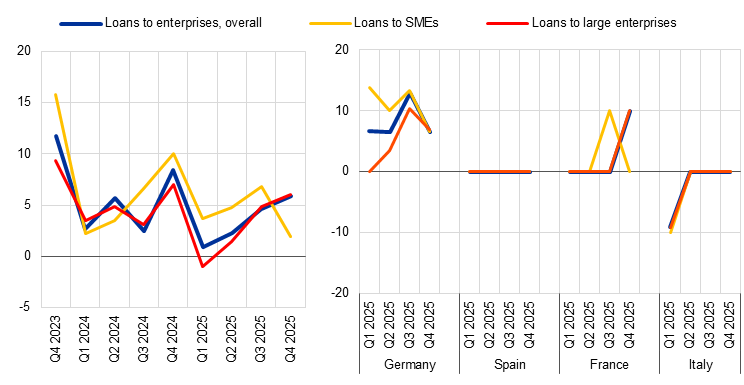
Notes: Share of rejected loan applications relative to the volume of all loan applications in that loan category. The breakdown by firm size was introduced in the first quarter of 2022. The full set of data underlying this chart can be downloaded via the following ECB Data Portal links: euro area and four largest euro area countries.
2.4 Demand for loans increased slightly
Firms’ demand for loans continued to increase slightly, in net terms, in the fourth quarter of 2025, with heterogeneity across countries, banks and firm sizes (net percentage of 3%; see Chart 6).[7] The net increase in loan demand was similar to the third quarter (2%) and exceeded the expectations reported by banks in that quarter (0%). Additionally, responses across banks showed some variation, with some banks noting an increase in loan demand while others observed a decrease. Across the largest euro area countries, banks reported a net increase in demand for loans to firms in Germany and Italy, whereas they reported a net decrease in Spain and France. Across firm sizes, demand for loans increased moderately for large firms but decreased slightly for SMEs (7% and -2% respectively, see Chart 7). SMEs may have been more hesitant to seek loans due to less favourable financing conditions compared with larger firms (see Section 2.2). Loan demand increased moderately for long-term loans and only slightly for short-term loans (8% and 2% respectively), although in both cases more than in the previous quarter.
Chart 6
Changes in demand for loans or credit lines to enterprises, and contributing factors
(net percentages of banks reporting an increase in demand, and contributing factors)

Notes: “Demand - actual” represents changes that have occurred, while “Demand - expected” represents changes anticipated by banks. Net percentages for the questions on demand for loans are defined as the difference between the sum of the percentages of banks responding “increased considerably” and “increased somewhat” and the sum of the percentages of banks responding “decreased somewhat” and “decreased considerably”. “Other financing needs” is the simple average of “mergers/acquisitions and corporate restructuring” and “debt refinancing/restructuring and renegotiation”. “Use of alternative finance” is the simple average of “internal financing”, “loans from other banks”, “loans from non-banks”, “issuance/redemption of debt securities” and “issuance/redemption of equity”. The net percentages for “Other factors” refer to an average of the further factors which were mentioned by banks as having contributed to changes in loan demand. The full set of data underlying this chart can be downloaded via the following ECB Data Portal links: euro area and four largest euro area countries.
Chart 7
Changes in demand for loans or credit lines to SMEs and large enterprises, and contributing factors
(net percentages of banks reporting an increase in demand, and contributing factors)

Notes: See the notes to Chart 6. The full set of data underlying this chart can be downloaded via the following ECB Data Portal links: loans to SMEs and loans to large enterprises.
Firms’ loan demand was primarily driven by an increase in demand for inventories and working capital and other financing needs, whereas fixed investment continued to make an overall neutral net contribution (see Chart 6 and Table 4). The increase in demand for inventories and working capital was the highest since the fourth quarter of 2022 and was concentrated in Germany and Italy. Additionally, debt refinancing/restructuring and mergers and acquisitions (within “other financing needs”) contributed positively to loan demand (mostly in the case of banks in France and Italy), while firms’ internal funds had a small dampening impact. The level of interest rates provided slight support to the increase in loan demand, although less than in previous quarters, with the supportive impact concentrated in Italy. This corresponds to the broad stabilisation of firms’ cost of bank borrowing, according to bank interest rate statistics, following declines observed until August 2025. Fixed investment continued to make an overall neutral net contribution to loan demand, dampened by the overall economic situation, while positive effects from infrastructure and defence spending were not yet visible. Across firm sizes, only large firms reported a net increase in financing needs for fixed investment, for the first time since the first quarter of 2022, whereas fixed investment continued to contribute negatively to SMEs’ loan demand (see Chart 7). Banks in Germany and Italy indicated a positive contribution from fixed investment, in combination with an increase in demand for long-term loans, while banks in France and Spain reported a negative impact from fixed investment.
Table 4
Factors contributing to changes in demand for loans or credit lines to enterprises
(net percentages of banks)
Country | Fixed investment | Inventories and working capital | Other financing needs | General level of interest rates | Use of alternative finance | |||||
|---|---|---|---|---|---|---|---|---|---|---|
Q3 2025 | Q4 2025 | Q3 2025 | Q4 2025 | Q3 2025 | Q4 2025 | Q3 2025 | Q4 2025 | Q3 2025 | Q4 2025 | |
Euro area | -1 | 0 | 0 | 8 | 3 | 5 | 3 | 2 | 0 | 0 |
Germany | 3 | 3 | 0 | 10 | 2 | 2 | 6 | 0 | 1 | 0 |
Spain | 0 | -17 | 0 | 0 | 4 | 0 | 17 | 0 | -3 | -2 |
France | -18 | -10 | -9 | 0 | 9 | 10 | -9 | 0 | 0 | 2 |
Italy | 9 | 9 | 0 | 9 | 5 | 18 | 0 | 9 | 2 | -4 |
Note: See the notes to Chart 6.
For the first quarter of 2026, banks expect firms’ loan demand to increase further (net percentage of 6%). They expect a moderate net increase in demand for loans to large firms and a lower net increase in demand for loans to SMEs (8% and 4% respectively), while they expect a moderate net increase in demand for long-term loans and a small increase in demand for short-term loans to euro area firms (6% and 3% respectively).
3 Loans to households for house purchase
3.1 Small easing of credit standards
Banks reported a small net easing of credit standards for housing loans in the fourth quarter of 2025 (net percentage of banks of -2%, see Chart 8 and Overview table).[8] The small easing of credit standards for housing loans was unexpected, as banks had anticipated a slight net tightening (2%). Among the four largest euro area countries, credit standards tightened in Germany, eased in France, and remained unchanged in Spain and Italy.
Chart 8
Changes in credit standards applied to the approval of loans to households for house purchase, and contributing factors
(net percentages of banks reporting a tightening of credit standards, and contributing factors)

Notes: “Credit standards - actual” are changes that have occurred, while “Credit standards - expected” are changes anticipated by banks. Net percentages are defined as the difference between the sum of the percentages of banks responding “tightened considerably” and “tightened somewhat” and the sum of the percentages of banks responding “eased somewhat” and “eased considerably”. “Cost of funds and balance sheet constraints” is the simple average of “banks’ capital and the costs related to banks’ capital positions”, “access to market financing” and “liquidity position” (the aggregate series was discontinued from the first quarter of 2022, when detailed sub-factors were introduced). “Risk perceptions” is the simple average of “general economic situation and outlook”, “housing market prospects, including expected house price developments” and “borrower’s creditworthiness”. “Competition” is the simple average of “competition from other banks” and “competition from non-banks”. The net percentages for “Other factors” refer to an average of the further factors which were mentioned by banks as having contributed to changes in credit standards. The full set of data underlying this chart can be downloaded via the following ECB Data Portal links: euro area and four largest euro area countries.
Competition had an easing impact on credit standards, while risk perceptions had a tightening impact (see Chart 8 and Table 5). Risk perceptions were one of the main factors behind the tightening of credit standards in Germany, reflecting banks’ views on the general economic situation and borrowers’ creditworthiness. Banks in Germany also reported a decline in risk tolerance as a major tightening factor. By contrast, banks in France indicated an increase in risk tolerance, coupled with an easing effect from competitive pressures from other banks.
In the first quarter of 2026, euro area banks expect to slightly tighten credit standards on housing loans (net percentage of 3%). Across the four largest euro area economies, the expected tightening is driven by banks in Germany and Spain, while banks in France anticipate a net easing, and banks in Italy expect unchanged credit standards.
Table 5
Factors contributing to changes in credit standards for loans to households for house purchase
(net percentages of banks)
Country | Cost of funds and balance sheet constraints | Pressure from competition | Perception of risk | Banks’ risk tolerance | ||||
|---|---|---|---|---|---|---|---|---|
Q3 2025 | Q4 2025 | Q3 2025 | Q4 2025 | Q3 2025 | Q4 2025 | Q3 2025 | Q4 2025 | |
Euro area | 0 | 0 | -2 | -3 | 0 | 3 | 0 | -1 |
Germany | 0 | 0 | 0 | 0 | 2 | 5 | 0 | 7 |
Spain | 0 | 0 | 0 | 0 | 0 | 0 | 0 | 0 |
France | 0 | 0 | 0 | -7 | 0 | 0 | 0 | -14 |
Italy | 0 | 0 | 0 | 0 | 0 | 0 | 0 | 0 |
Note: See the notes to Chart 8.
3.2 Moderate net easing of terms and conditions
Euro area banks reported a moderate net easing of overall credit terms and conditions for housing loans in the fourth quarter of 2025 (net percentage of -4%; see Chart 9 and Table 6). This followed a similar easing of terms and conditions reported in the third quarter.[9] Narrower margins on average loans contributed to this easing, while developments in lending rates made a strong contribution to tightening for the first time since the start of data collection for this factor in the first quarter of 2024. This is consistent with the steepening of the euro area risk-free yield curve over the last quarter, which has translated into upward pressures on mortgage rates. Among the largest euro area countries, banks in Germany reported a net easing of terms and conditions, driven by narrower margins on both average and riskier loans. Banks in France also reported a net easing, with narrower margins on average loans, although lending rates had a tightening impact. In Italy, terms and conditions remained unchanged despite an easing impact from margins on average loans. In Spain, terms and conditions tightened owing to higher margins on average loans and higher lending rates.
Chart 9
Changes in terms and conditions on loans to households for house purchase
(net percentages of banks reporting a tightening of terms and conditions)

Notes: “Overall terms and conditions” are the actual terms and conditions agreed in the loan contract. “Lending rates” was introduced in April 2024. “Margins” are defined as the spread over relevant market reference rates. “Other terms and conditions” is the simple average of “loan-to-value ratio”, “other loan size limits”, “non-interest rate charges” and “maturity”. The net percentages for “Other components” refer to an average of the further terms and conditions components which were mentioned by banks as having contributed to changes in overall terms and conditions. The full set of data underlying this chart can be downloaded via the following ECB Data Portal links: euro area and four largest euro area countries.
Table 6
Changes in terms and conditions on loans to households for house purchase
(net percentages of banks)
Country | Overall terms and conditions | Banks’ lending rates | Banks’ margins on average loans | Banks’ margins on riskier loans | ||||
|---|---|---|---|---|---|---|---|---|
Q3 2025 | Q4 2025 | Q3 2025 | Q4 2025 | Q3 2025 | Q4 2025 | Q3 2025 | Q4 2025 | |
Euro area | -5 | -4 | -2 | 14 | -2 | -7 | 6 | 0 |
Germany | 15 | -4 | 7 | 0 | 7 | -7 | 11 | -4 |
Spain | -20 | 10 | -10 | 10 | -10 | 10 | 0 | 0 |
France | -13 | -14 | -13 | 43 | -13 | -14 | 0 | 0 |
Italy | -18 | 0 | -9 | 0 | -9 | -9 | 0 | 0 |
Note: See the notes to Chart 9.
In the fourth quarter of 2025, competition had a net easing impact on terms and conditions, while risk perceptions had a net tightening effect and other factors had a broadly neutral impact (see Table 7). The net easing impact of competition was stronger than in the previous quarter and was reported by banks in Germany, France and Italy, whereas in Spain competition had a neutral impact. Banks’ costs of funds and balance sheet constraints, mainly related to capital costs, had a net tightening impact in France, while they had a neutral effect on terms and conditions in the other large euro area economies. Banks’ risk perceptions had a tightening impact in Germany and Spain, while banks’ risk tolerance had a tightening impact only in Germany.
Table 7
Factors contributing to changes in overall terms and conditions on loans to households for house purchase
(net percentages of banks)
Country | Cost of funds and | Pressure from | Perception of risk | Banks’ risk tolerance | ||||
|---|---|---|---|---|---|---|---|---|
Q3 2025 | Q4 2025 | Q3 2025 | Q4 2025 | Q3 2025 | Q4 2025 | Q3 2025 | Q4 2025 | |
Euro area | 1 | 1 | -3 | -7 | -1 | 2 | 1 | 1 |
Germany | 2 | 0 | 7 | -7 | 0 | 4 | 4 | 4 |
Spain | 0 | 0 | -20 | 0 | 0 | 10 | 0 | 0 |
France | 0 | 5 | 0 | -14 | 0 | 0 | 0 | 0 |
Italy | 3 | 0 | -9 | -9 | 9 | 0 | 0 | 0 |
Notes: The net percentages for these questions relating to contributing factors are defined as the difference between the percentage of banks reporting that the given factor contributed to a tightening and the percentage of banks reporting that it contributed to an easing. “Cost of funds and balance sheet constraints” is the simple average of “banks’ capital and the costs related to banks’ capital positions”, “access to market financing” and “liquidity position” (the aggregate series was discontinued from the first quarter 2024, when detailed sub-factors were introduced). The full set of data underlying this chart can be downloaded via the following ECB Data Portal links: euro area and four largest euro area countries.
3.3 Rejection rates for housing loans remained unchanged
The share of rejected housing loan applications remained unchanged in the fourth quarter of 2025 (net percentage of 0%; see Chart 10). This result follows the increasing share recorded in the preceding quarter. Across the four largest euro area countries, the share of rejections increased in Spain, decreased in Italy, and remained unchanged in Germany and France.
Chart 10
Changes in the share of rejected loan applications for households
(net percentages of banks reporting an increase)

Notes: Share of rejected loan applications relative to the volume of all loan applications in that loan category. The full set of data underlying this chart can be downloaded via the following ECB Data Portal links: euro area and four largest euro area countries.
3.4 Moderate increase in loan demand
Banks reported an additional, albeit more moderate, net increase in demand for housing loans in the fourth quarter of 2025 (net percentage of 9%, see Chart 11 and Overview table).[10] The net increase was lower than in the previous quarter (28%) and broadly in line with banks’ expectations (8%). A net increase in demand was reported in the four largest euro area economies. This seventh consecutive quarter of net increases in housing loan demand is consistent with the gradual rise in volumes of loans to households for house purchase.
Chart 11
Changes in demand for loans to households for house purchase, and contributing factors
(net percentages of banks reporting an increase in demand, and contributing factors)
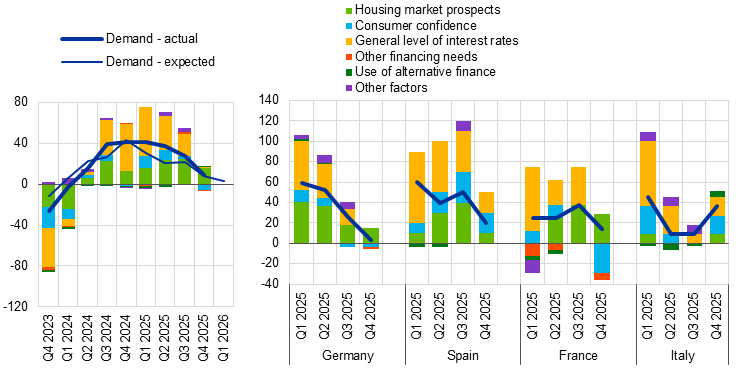
Notes: “Demand - actual” represents changes that have occurred, while “Demand - expected” represents changes anticipated by banks. Net percentages for the questions on demand for loans are defined as the difference between the sum of the percentages of banks responding “increased considerably” and “increased somewhat” and the sum of the percentages of banks responding “decreased somewhat” and “decreased considerably”. “Other financing needs” is the simple average of “debt refinancing/restructuring and renegotiation” and “regulatory and fiscal regime of housing markets”. “Use of alternative finance” is the simple average of “internal finance of house purchase out of savings/down payment”, “loans from other banks” and “other sources of external finance”. The net percentages for “Other factors” refer to an average of the further factors which were mentioned by banks as having contributed to changes in loan demand. The full set of data underlying this chart can be downloaded via the following ECB Data Portal links: euro area and four largest euro area countries.
Improved housing market prospects were the main driver of the increase in housing loan demand, while consumer confidence contributed negatively (see Chart 11 and Table 8). Developments in interest rates contributed only very slightly to the net increase in demand. Banks reported a markedly lower positive impact of interest rates than the figure for the previous quarter and the average since the first quarter of 2024, but this was offset by a negative contribution from other financing needs. Housing market prospects had a positive impact on demand across the largest euro area economies. Consumer confidence supported demand in Italy and Spain, while it had a dampening effect in Germany and France. Demand in Spain and Italy was also supported by the general level of interest rates, whereas this factor was neutral in Germany and France. Banks in the latter two countries reported a net negative impact of other financing needs on demand. The impact of other financing needs was neutral in Spain and Italy. Finally, the use of alternative finance, related to internal finance from savings and to loans from other banks, contributed to the increase in housing loan demand in Italy, while it had no impact in the other large countries.
In the first quarter of 2026, banks expect housing loan demand to grow further, albeit only slightly (net percentage of 3%). Banks in Germany and Italy expect a net increase in loan demand, banks in Spain anticipate no change, while banks in France foresee a decline.
Table 8
Factors contributing to changes in demand for loans to households for house purchase
(net percentages of banks)
Country | Housing market prospects | Consumer confidence | Other financing needs | General level of interest rates | Use of alternative finance | |||||
|---|---|---|---|---|---|---|---|---|---|---|
Q3 2025 | Q4 2025 | Q3 2025 | Q4 2025 | Q3 2025 | Q4 2025 | Q3 2025 | Q4 2025 | Q3 2025 | Q4 2025 | |
Euro area | 25 | 16 | 3 | -6 | 2 | -2 | 21 | 2 | -1 | 1 |
Germany | 19 | 15 | -4 | -4 | 0 | -2 | 15 | 0 | 0 | 0 |
Spain | 40 | 10 | 30 | 20 | 0 | 0 | 40 | 20 | 0 | 0 |
France | 38 | 29 | 0 | -29 | 0 | -7 | 38 | 0 | 0 | 0 |
Italy | 0 | 9 | 0 | 18 | 0 | 0 | 9 | 18 | -3 | 6 |
Note: See the notes to Chart 11.
4 Consumer credit and other lending to households
4.1 Moderate tightening of credit standards
Banks reported a moderate net tightening of credit standards on consumer credit and other lending to households in the fourth quarter of 2025 (net percentage of 6%; see Chart 12 and Overview table).[11] Credit standards on consumer credit tightened further and at a similar pace to the previous quarter (5%). The net tightening was slightly above euro area banks’ expectations in the previous quarter (4%). It was also in line with perceived risks to credit quality for consumer credit, which had a net tightening impact (see Section 5.3). Credit standards tightened across all the larger euro area economies, with the current tightening exceeding historical averages in Germany, France and Italy. In Spain and France, the tightening followed a quarter in which credit standards were unchanged, while in Germany and Italy credit standards had already tightened in that quarter.
Chart 12
Changes in credit standards applied to the approval of consumer credit and other lending to households, and contributing factors
(net percentages of banks reporting a tightening of credit standards, and contributing factors)
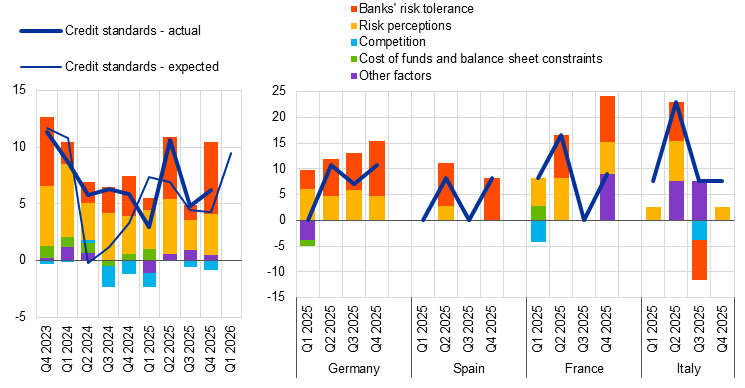
Notes: “Credit standards - actual” are changes that have occurred, while “Credit standards - expected” are changes anticipated by banks. Net percentages are defined as the difference between the sum of the percentages of banks responding “tightened considerably” and “tightened somewhat” and the sum of the percentages of banks responding “eased somewhat” and “eased considerably”. “Cost of funds and balance sheet constraints” is the simple average of “banks’ capital and the costs related to banks’ capital position”, “access to market financing” and “liquidity position” (the aggregate series was discontinued from the first quarter of 2022, when detailed sub-factors were introduced). “Risk perceptions” is the simple average of “general economic situation and outlook”, “creditworthiness of consumers” and “risk on the collateral demanded”. “Competition” is the simple average of “competition from other banks” and “competition from non-banks”. The net percentages for “Other factors” refer to an average of the further factors which were mentioned by banks as having contributed to changes in credit standards. The full set of data underlying this chart can be downloaded via the following ECB Data Portal links: euro area and four largest euro area countries.
The main drivers of the net tightening of credit standards for consumer credit were banks’ lower risk tolerance and a deterioration in banks’ risk perceptions (see Chart 12 and Table 9). Higher risk perceptions were driven by concerns about both borrowers’ creditworthiness (6%) and the general economic outlook (4%). Competition and banks’ cost of funds and balance sheet constraints had a broadly neutral impact. In Germany and France, banks’ lower risk tolerance and higher perceived risks contributed to the tightening. In Italy, risk perceptions were mentioned as a driver of the tightening, while in Spain the net tightening was driven by banks’ lower risk tolerance.
In the first quarter of 2026, euro area banks expect credit standards for consumer credit and other lending to households to tighten more markedly (net percentage of 9%). Across the four largest euro area economies, banks in Germany, France and Italy expect a further net tightening, while banks in Spain expect unchanged credit standards.
Table 9
Factors contributing to changes in credit standards for consumer credit and other lending to households
(net percentages of banks)
Country | Cost of funds and balance sheet constraints | Pressure from competition | Perception of risk | Banks’ risk tolerance | ||||
|---|---|---|---|---|---|---|---|---|
Q3 2025 | Q4 2025 | Q3 2025 | Q4 2025 | Q3 2025 | Q4 2025 | Q3 2025 | Q4 2025 | |
Euro area | 0 | 0 | -1 | -1 | 3 | 4 | 1 | 6 |
Germany | 0 | 0 | 0 | 0 | 6 | 5 | 7 | 11 |
Spain | 0 | 0 | 0 | 0 | 0 | 0 | 0 | 8 |
France | 0 | 0 | 0 | 0 | 0 | 6 | 0 | 9 |
Italy | 0 | 0 | -4 | 0 | 0 | 3 | -8 | 0 |
Note: See the notes to Chart 12.
4.2 Terms and conditions tightened somewhat
Banks’ overall terms and conditions applied when granting consumer credit and other lending to households tightened somewhat in the fourth quarter of 2025 (net percentage of 4%; see Chart 13 and Table 10). This followed a small net easing of terms and conditions in the previous quarter.[12] Margins on average loans had a net easing impact, but this was offset by higher margins on riskier loans, higher lending rates (consistent with the uptick in the short and long-term risk-free rates in the euro area over the last quarter) and idiosyncratic factors. The pattern of lower margins for average loans and higher margins for riskier loans suggests that banks are discriminating more by borrower risk profile and is also consistent with increased risk aversion on the part of banks. Across the four largest euro area economies, overall terms and conditions tightened in France and Italy, while they remained unchanged in Spain and Germany. In France, margins on average loans had an easing impact, but margins on riskier loans and lending rates had a tightening impact. In Italy, margins on both average and riskier loans, as well as lending rates, contributed to the tightening. In Germany and Spain, margins on riskier loans had a net tightening impact.
Banks’ higher risk perceptions and lower risk tolerance contributed to the tightening of overall terms and conditions, while competition had an easing impact (see Table 11). Competition had an easing impact in all large euro area countries except Italy, where it had a tightening impact. Cost of funds and balance sheet constraints, mainly related to market financing, had a small easing effect in Italy. Banks in Spain and France reported lower risk tolerance, while among the largest euro area economies risk perceptions increased in France.
Chart 13
Changes in terms and conditions on consumer credit and other lending to households
(net percentages of banks reporting a tightening of terms and conditions)
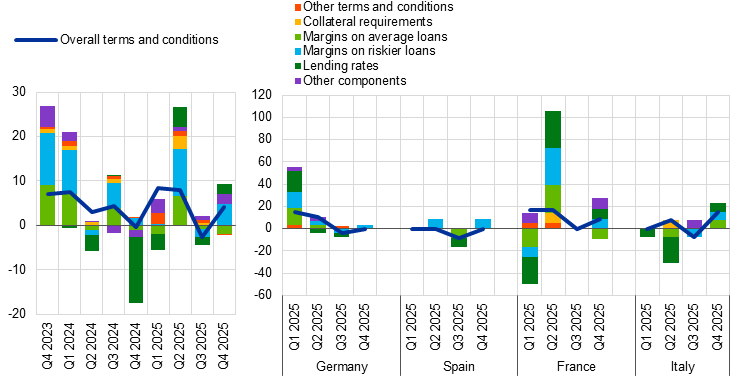
Notes: “Overall terms and conditions” are the actual terms and conditions agreed in the loan contract. “Lending rates” was introduced in April 2024. “Margins” are defined as the spread over a relevant market reference rate. “Other terms and conditions” is the simple average of “size of the loan”, “non-interest rate charges” and “maturity”. The net percentages for “Other components” refer to an average of the further terms and conditions components which were mentioned by banks as having contributed to changes in overall terms and conditions. The full set of data underlying this chart can be downloaded via the following ECB Data Portal links: euro area and four largest euro area countries.
Table 10
Changes in terms and conditions on consumer credit and other lending to households
(net percentages of banks)
Country | Overall terms and conditions | Banks’ lending rates | Banks’ margins on average loans | Banks’ margins on riskier loans | ||||
|---|---|---|---|---|---|---|---|---|
Q3 2025 | Q4 2025 | Q3 2025 | Q4 2025 | Q3 2025 | Q4 2025 | Q3 2025 | Q4 2025 | |
Euro area | -3 | 4 | -2 | 2 | -1 | -2 | -2 | 5 |
Germany | -4 | 0 | -4 | 0 | 0 | 0 | -4 | 4 |
Spain | -8 | 0 | -8 | 0 | -8 | 0 | 0 | 8 |
France | 0 | 9 | 0 | 9 | 0 | -9 | 0 | 9 |
Italy | -8 | 15 | 0 | 8 | 0 | 8 | -8 | 8 |
Note: See the notes to Chart 13.
Table 11
Factors contributing to changes in overall terms and conditions on consumer credit and other lending to households
(net percentages of banks)
Country | Cost of funds and balance sheet constraints | Pressure from competition | Perception of risk | Banks’ risk tolerance | ||||
|---|---|---|---|---|---|---|---|---|
Q3 2025 | Q4 2025 | Q3 2025 | Q4 2025 | Q3 2025 | Q4 2025 | Q3 2025 | Q4 2025 | |
Euro area | 0 | 0 | -1 | -4 | 0 | 5 | 0 | 3 |
Germany | -1 | 1 | 0 | -4 | 0 | 0 | 4 | 0 |
Spain | 0 | 0 | 0 | -8 | -8 | 0 | -8 | 8 |
France | 0 | 0 | 0 | -9 | 0 | 18 | 0 | 9 |
Italy | 0 | -3 | -8 | 8 | 8 | 0 | 0 | 0 |
Notes: The net percentages for these questions relating to contributing factors are defined as the difference between the percentage of banks reporting that the given factor contributed to a tightening and the percentage of banks reporting that it contributed to an easing. “Cost of funds and balance sheet constraints” is the simple average of “banks’ capital and the costs related to banks’ capital positions”, “access to market financing” and “liquidity position” (the aggregate series was discontinued from the first quarter of 2024, when detailed sub-factors were introduced). The full set of data underlying this chart can be downloaded via the following ECB Data Portal links: euro area and four largest euro area countries.
4.3 Rejection rates increased again
Euro area banks reported an increase in the net share of rejected loan applications for consumer credit (net percentage of 8%; see Chart 10). The reported increase was lower than that reported in the previous quarter although it was higher than the historical average (4%). Banks in Germany and France reported an increase in the share of rejections, while banks in Spain and Italy reported a net decrease.
4.4 Demand for consumer credit decreased slightly
Banks reported slightly lower demand, in net terms, for consumer credit and other lending to households (net percentage of -2%; see Chart 14 and Overview table).[13] This followed broadly unchanged demand in the previous quarter and was somewhat lower than banks’ expectations for that quarter (2%). Demand declined in France, remained unchanged in Germany and Spain and increased in Italy.
Lower consumer confidence was the main driver of the small decline in demand, while the general level of interest rates made a positive contribution (see Chart 14 and Table 12). Consumer confidence dampened consumer credit demand in Germany and France, while it had a neutral impact in Spain and a positive impact in Italy. The general level of interest rates supported demand in France and Italy, whereas it had a neutral impact in Germany and Spain. Spending on durable goods had a negative impact in France, a neutral impact in Spain and a positive impact in Germany and Italy. The use of alternative finance – mainly internal finance from savings – was also a factor supporting loan demand in Italy.
Chart 14
Changes in demand for consumer credit and other lending to households, and contributing factors
(net percentages of banks reporting an increase in demand, and contributing factors)

Notes: “Demand - actual” represents changes that have occurred, while “Demand - expected” are changes anticipated by banks. Net percentages for the questions on demand for loans are defined as the difference between the sum of the percentages of banks responding “increased considerably” and “increased somewhat” and the sum of the percentages of banks responding “decreased somewhat” and “decreased considerably”. “Use of alternative finance” is the simple average of “internal financing out of savings”, “loans from other banks” and “other sources of external finance”. “Consumption exp. (real estate)” denotes “consumption expenditure financed through real estate-guaranteed loans”. The net percentages for “Other factors” refer to an average of the further factors which were mentioned by banks as having contributed to changes in loan demand. The full set of data underlying this chart can be downloaded via the following ECB Data Portal links: euro area and four largest euro area countries.
For the first quarter of 2026, banks expect a small increase in loan demand for consumer credit and other lending to households (net percentage of 2%). Demand for consumer credit is expected to increase in Italy, to decrease in Germany, and to remain unchanged in Spain and France.
Table 12
Factors contributing to changes in demand for consumer credit and other lending to households
(net percentages of banks)
Country | Spending on durable goods | Consumer confidence | Consumption exp. (real estate) | General level of interest rates | Use of alternative finance | |||||
|---|---|---|---|---|---|---|---|---|---|---|
Q3 2025 | Q4 2025 | Q3 2025 | Q4 2025 | Q3 2025 | Q4 2025 | Q3 2025 | Q4 2025 | Q3 2025 | Q4 2025 | |
Euro area | 1 | -1 | -8 | -3 | 0 | 0 | 2 | 4 | 0 | 0 |
Germany | 7 | 4 | -7 | -4 | 0 | 0 | 4 | 0 | 0 | 0 |
Spain | 8 | 0 | 8 | 0 | 0 | 0 | 8 | 0 | 0 | 0 |
France | -17 | -18 | -25 | -9 | 0 | 0 | 0 | 9 | 0 | 0 |
Italy | -8 | 15 | 0 | 8 | 0 | 0 | 0 | 8 | 0 | 3 |
Note: See the notes to Chart 14.
5 Ad hoc questions
5.1 Banks’ access to funding deteriorated slightly for retail funding and money markets and improved for debt securities and securitisations
Euro area banks’ access to retail funding and money markets deteriorated slightly in the fourth quarter of 2025, while it eased for debt securities and securitisations (Chart 15 and Table 13).[14] Access to short-term retail funding remained unchanged, whereas access to long-term retail funding became slightly more difficult. This is broadly in line with the stability of overnight deposit rates in the euro area, while term deposit rates increased marginally in the last quarter, according to bank interest rate statistics. Banks reported a slight deterioration in access to money market funding. Access to debt securities funding eased, with the improvement concentrated in medium to long‑term securities. Finally, banks reported a slight improvement in access to the securitisation market.
Chart 15
Changes in banks’ access to retail and wholesale funding
(net percentages of banks reporting a deterioration in access)

Notes: Net percentages are defined as the difference between the sum of the percentages of banks responding “deteriorated considerably” and “deteriorated somewhat” and the sum of the percentages of banks responding “eased somewhat” and “eased considerably”. “Retail funding” is the simple average of “short-term deposits (up to one year)” and “long-term deposits (more than one year)” and other retail funding instruments; “Money markets” refers to the interbank unsecured money market and is the simple average of “very short-term money market (up to one week)” and “short-term money market (more than one week)”; “Debt securities” is the simple average of “short-term debt securities (e.g. certificates of deposit or commercial paper)” and “medium to long-term debt securities (incl. covered bonds)”. “Securitisation” is the simple average of “securitisation of corporate loans”, “securitisation of loans for house purchase” and “ability to transfer credit risk off balance sheet”. The last period shows expectations indicated by banks in the current round. The full set of data underlying this chart can be downloaded via the following ECB Data Portal link: changes in banks’ access to retail and wholesale funding.
In the first quarter of 2026, banks expect access to retail and money market funding and to securitisation markets to remain broadly unchanged, and to ease slightly for debt securities funding. Euro area banks anticipate slightly better access to short‑term retail funding and a small deterioration in access to long‑term retail funding. For debt securities, banks expect moderately better access to medium to long‑term instruments and broadly unchanged access to short‑term securities.
Table 13
Changes in bank access to retail and wholesale funding
(net percentages of banks reporting a deterioration in access)
Retail funding | Money markets | Debt securities | Securiti-sation | |||||
|---|---|---|---|---|---|---|---|---|
Total | Short-term | Long-term | Total | Short-term | Medium to | |||
Q3 2025 | -1 | -2 | -1 | -2 | -8 | -3 | -12 | -2 |
Q4 2025 | 2 | 0 | 3 | 2 | -5 | 3 | -12 | -2 |
Q1 2026 | 1 | -2 | 4 | 1 | -2 | 1 | -5 | 0 |
Notes: See the notes to Chart 15. The last period shows expectations indicated by banks in the current round.
5.2 Banks increased their capital and liquidity while reducing their risk-weighted assets and tightening their credit standards in response to regulatory and supervisory actions
In response to new regulatory and supervisory actions, euro area banks reported a net increase in their capital and in their holdings of liquid assets, while indicating a decline in risk-weighted assets (see Chart 16 and Table 14).[15] Higher capital levels were supported by both retained earnings and the issuance of new capital. The net increase in capital is qualitatively consistent, among other factors, with the 2024 Supervisory Review and Evaluation Process (SREP), which entailed slightly higher Pillar 2 requirements for CET1 capital for 2025. It is also in line with the increase of macroprudential buffers announced by some national authorities during 2025. Additionally, supervisors have made efforts to enhance banks’ resilience to geopolitical shocks, for example by asking them to implement currency-specific liquidity buffers.[16] Amid heightened uncertainty and increased credit risks, these developments have contributed to banks adopting a more cautious approach to managing their portfolios, focusing on increasing their holdings of liquid assets while reducing their exposure to risk-weighted assets. Within the latter, banks reported lower exposures to average loans, while exposures to riskier loans remained broadly unchanged. This could be the result of borrowers previously considered as safer migrating into higher-risk categories despite banks’ low risk tolerance. Additionally, the transition to the new Capital Requirements Regulation (CRR III) may have played a role in the reduction in risk-weighted assets, among other things. Despite the reduction in risk-weighted assets, banks noted an increase in their total assets as liquid assets increased as a result of regulatory and supervisory actions. Finally, banks indicated that these measures had a broadly neutral effect on their funding conditions.
Chart 16
Impact of regulatory or supervisory actions on banks’ assets, capital and funding conditions
(net percentages of banks reporting an increase)

Notes: For “Total assets”, “Risk-weighted assets”, “Liquid assets” and “Capital”, the net percentages are defined as the difference between the sum of the percentages of banks responding “increased considerably” and “increased somewhat” and the sum of the percentages for “decreased somewhat” and “decreased considerably”. For “Banks’ funding conditions”, the net percentages are defined as the difference between the sum of the percentages of banks responding “experienced a considerable tightening” and “experienced a moderate tightening” and the sum of the percentages for “experienced a moderate easing” and “experienced a considerable easing”. The last period denotes expectations indicated by banks in the current round.
Table 14
Impact of regulatory or supervisory actions on banks’ assets, capital and funding conditions
(net percentages of banks reporting an increase)
Total assets | Risk-weighted assets | Capital | Funding conditions | ||||||
|---|---|---|---|---|---|---|---|---|---|
Total | Liquid assets | Total | Average loans | Riskier loans | Total | Retained earnings | Capital issuance | ||
2024 | 10 | 10 | 10 | 12 | 3 | 20 | 15 | 10 | -5 |
2025 | 7 | 8 | -6 | -5 | 1 | 15 | 12 | 8 | 0 |
2026 | 8 | 4 | 9 | 10 | 4 | 19 | 13 | 9 | 1 |
Notes: See the notes to Chart 16. The last period denotes expectations indicated by banks in the current round.
Supervisory or regulatory actions were reported to have a net tightening impact on banks’ credit standards across all loan categories in 2025 (see Chart 17 and Table 15). The additional tightening impact was lower than in 2024 for loans to SMEs, loans to large firms and consumer credit, while it was similar for housing loans.
Chart 17
Impact of regulatory or supervisory actions on banks’ credit standards and margins
(net percentages of banks reporting a tightening impact)

Notes: The net percentages for the impact of regulatory or supervisory action on banks’ credit standards are defined as the difference between the sum of the percentages of banks responding “tightened considerably” and “tightened somewhat” and the sum of the percentages of banks responding “eased somewhat” and “eased considerably”. The last period denotes expectations indicated by banks in the current round.
Looking ahead to 2026, euro area banks expect that regulatory and supervisory actions will result in higher capital, higher risk‑weighted assets and higher liquid assets, and they also anticipate further net tightening of credit standards. The expected net increase in capital in 2026 is slightly higher than it was in 2025. This may reflect the impact of the ongoing implementation of the output floor and related reforms in the context of the new Capital Requirements Regulation (CRR3), which are expected to gradually raise overall capital needs over time. These initiatives may also explain the anticipated increase in risk‑weighted assets, insofar as they could lead to higher effective risk weights by, for example, constraining the use of internal models. This would offset lower non-binding Pillar 2 guidance for 2026, as well as certain supervisory initiatives (e.g. the announced reform of SREP) seeking to simplify current reporting and regulatory requirements. Finally, banks expect to hold higher liquid assets. This might reflect, among other things, liquidity needs related to geopolitical uncertainty and ongoing supervisory scrutiny consistent with supervisory priorities for 2026-28.[17] Against this backdrop, banks anticipate an additional net tightening of credit standards in 2026.
Table 15
Impact of regulatory or supervisory actions on banks’ credit standards
(net percentages of banks reporting a tightening impact)
2024 | 2025 | 2026 | |
|---|---|---|---|
Loans and credit lines to SMEs | 11 | 7 | 4 |
Loans and credit lines to large enterprises | 13 | 10 | 9 |
Loans to households for house purchase | 8 | 7 | 12 |
Consumer credit and other lending to households | 8 | 5 | 7 |
Notes: See the notes to Chart 17. The last period denotes expectations indicated by banks in the current round.
5.3 Risks to credit quality had a small additional net tightening impact on credit standards
Euro area banks reported a small net tightening impact of NPL ratios and other credit quality indicators on their credit standards for loans to firms, housing loans and consumer credit (net percentages of 3%, 2% and 6% respectively) in the fourth quarter of 2025 (see Chart 18 and Table 16).[18] The net tightening of credit standards for loans to firms was unchanged on the previous quarter (3%) and was broadly in line with previous expectations. By contrast, for housing loans and consumer credit the net tightening was higher than in the previous quarter, when the impact of credit quality indicators on credit standards had been neutral, and was broadly in line with previous expectations.
Chart 18
Impact of banks’ NPL ratios and other credit quality indicators on credit standards
(net percentages of banks reporting a tightening impact)

Notes: Net percentages are defined as the difference between the sum of the percentages of banks responding “contributed considerably to tightening” and “contributed somewhat to tightening” and the sum of the percentages of banks responding “contributed somewhat to easing” and “contributed considerably to easing”. The last period shows expectations indicated by banks in the current round. The full set of data underlying this chart can be downloaded via the following ECB Data Portal link: impact of banks’ NPL ratios and other indicators of credit quality on credit standards.
Table 16
Impact of banks’ NPL ratios and other credit quality indicators on credit standards
(net percentages of banks reporting a tightening impact)
Q3 2025 | Q4 2025 | Q1 2026 | |
|---|---|---|---|
Loans to enterprises | 3 | 3 | 4 |
Loans to households for house purchase | 0 | 2 | 1 |
Consumer credit and other lending to households | 0 | 6 | 5 |
Notes: See the notes to Chart 18. The last period shows expectations indicated by banks in the current round.
Banks indicated that higher risk perceptions, lower risk tolerance and costs related to their capital position contributed to the net tightening of credit standards (see Chart 19 and Table 17). Other factors, such as costs related to balance sheet clean-up, pressure stemming from supervisory or regulatory requirements, access to market financing and the liquidity position of banks, had a broadly neutral impact. This follows the short-lived net easing impact reported for most of these factors in the third quarter, following the tightening impact reported by banks in earlier quarters.
Chart 19
Impact of factors through which NPL ratios and other credit quality indicators affect banks’ policies on lending to enterprises and households
(net percentages of banks reporting a tightening impact)

Notes: See the notes to Chart 18. As of Q4 2025, banks’ policies on lending refer to the impact on credit standards, while the impact on terms and conditions is no longer included. The last period shows expectations indicated by banks in the current round. The full set of data underlying this chart can be downloaded via the following ECB Data Portal link: impact of factors through which NPL ratios and other indicators of asset quality affect banks’ policies on lending to enterprises and households.
Table 17
Impact of factors through which NPL ratios and other credit quality indicators affect banks’ policies on lending to enterprises and households
(net percentages of banks reporting a tightening impact)
Q3 2025 | Q4 2025 | Q1 2026 | |
|---|---|---|---|
Costs related to banks’ capital positions | -5 | 2 | 3 |
Costs related to balance sheet clean-up operations | -1 | 0 | 1 |
Supervisory or regulatory requirements | 1 | 1 | 3 |
Access to market financing | -2 | 0 | 0 |
Liquidity position | -3 | 0 | 0 |
Perception of risk | -2 | 5 | 6 |
Banks’ risk tolerance | -2 | 3 | 4 |
Notes: See the notes to Chart 19. The last period shows expectations indicated by banks in the current round.
In the first quarter of 2026, euro area banks expect a further small tightening impact of credit quality on their credit standards for loans to firms and for consumer credit. Banks anticipate that various factors, such as the costs related to their capital position, higher pressure from supervisory or regulatory requirements, higher risk perceptions and lower risk tolerance, will have a tightening impact.
5.4 Net tightening of credit standards in several economic sectors
Credit standards tightened in construction, wholesale and retail trade, energy-intensive manufacturing and commercial real estate (CRE) in the second half of 2025, with the net tightening being strongest in the manufacturing of motor vehicles (a new breakdown which was added in this survey round) (see Chart 20 and Table 18).[19] The net tightening remained moderate in the overall manufacturing sector, while non-financial services other than CRE saw no or only small net tightening. Credit standards tightened only slightly in the services sector (excluding financial services and real estate) and remained unchanged in residential real estate (RRE), following a net easing in the first half of 2025. Changes in credit standards across economic sectors appear broadly consistent with the overall net tightening of credit standards for all firms (see Section 2.1) in 2025.
Chart 20
Changes in credit standards for new loans to enterprises across main economic sectors
(net percentages of banks reporting a tightening)

Notes: Net percentages refer to the difference between the sum of the percentages of banks responding “tightened considerably” and “tightened somewhat” and the sum of the percentages of banks responding “eased somewhat” and “eased considerably”. Manufacturing of motor vehicles includes supply chain producers: it was introduced in the fourth quarter of 2025. The last period shows expectations indicated by banks in the current round. The full set of data underlying this chart can be downloaded via the following ECB Data Portal link: changes in credit standards for new loans to enterprises across main economic sectors.
For the first half of 2026, euro area banks expect either a further net tightening or broadly unchanged credit standards across the main economic sectors. Banks expect only a small net tightening for the manufacturing sector, although tightening could be more pronounced for the energy-intensive and motor vehicle segments. In addition, a moderate net tightening is expected for construction and the wholesale and retail trade sector, and broadly unchanged credit standards are expected for CRE, RRE and other non-financial services.
Banks reported a net increase in demand for loans in RRE and services (excluding financial services and real estate), whereas demand for loans remained broadly unchanged or declined slightly in the other main economic sectors in the second half of 2025 (see Chart 21 and Table 18). The net increase in loan demand in RRE and services in the second half of 2025 followed a smaller net increase and decline, respectively, in the first half of 2025. In addition, net demand for loans remained broadly unchanged in the second half of 2025 in manufacturing, construction, wholesale and retail trade and CRE, after net decreases in the first half of the year. Banks reported a small net decrease in loan demand in energy-intensive manufacturing and the manufacturing of motor vehicles. The changes in demand are, overall, consistent with the small net increase in the demand for loans to all firms (see Section 2.4).
For the first half of 2026, euro area banks expect a net increase in loan demand for most of the main economic sectors, consistent with the expected net increase in demand for loans to all firms. Loan demand is expected to increase in construction, RRE, manufacturing and services, while banks expect loan demand to remain broadly unchanged in CRE and to decrease slightly in wholesale and retail trade. With regard to the breakdowns of the manufacturing sector, banks expect a small net increase in loan demand for energy-intensive manufacturing and a further small decrease in demand for the manufacturing of motor vehicles.
Chart 21
Changes in demand for loans or credit lines to enterprises across main economic sectors
(net percentages of banks reporting an increase)

Notes: Net percentages refer to the difference between the sum of the percentages of banks responding “increased considerably” and “increased somewhat” and the sum of the percentages of banks responding “decreased somewhat” and “decreased considerably”. Manufacturing of motor vehicles includes supply chain producers: it was introduced in the fourth quarter of 2025. The last period shows expectations indicated by banks in the current round. The full set of data underlying this chart can be downloaded via the following ECB Data Portal link: changes in demand for loans or credit lines to enterprises across main economic sectors.
Table 18
Changes in credit standards and demand for new loans to enterprises across the main economic sectors
(net percentages of banks reporting a tightening/increase)
Credit standards | Loan demand | |||||
|---|---|---|---|---|---|---|
Q1– Q2 2025 | Q3– Q4 2025 | Q1– Q2 2026 | Q1– Q2 2025 | Q3– Q4 2025 | Q1– Q2 2026 | |
Manufacturing | 7 | 6 | 2 | -14 | 1 | 5 |
Of which: energy-intensive manufacturing | 5 | 10 | 6 | -12 | -4 | 3 |
Of which: manufacturing of motor vehicles | 21 | 12 | -3 | -3 | ||
Construction | 2 | 10 | 5 | -15 | -1 | 9 |
Services (excluding financial services and real estate) | -2 | 2 | -1 | -2 | 7 | 3 |
Wholesale and retail trade | 5 | 11 | 4 | -6 | 0 | -2 |
Commercial real estate | 9 | 13 | 1 | -8 | -1 | -1 |
Residential real estate | -3 | 0 | 0 | 8 | 14 | 6 |
Notes: See the notes to Charts 20 and 21. Manufacturing of motor vehicles includes supply chain producers: it was introduced in the fourth quarter of 2025. The last period shows expectations indicated by banks in the current round.
5.5 Changes in trade policies and the related uncertainty led to tighter credit standards and lower demand for loans to firms
In a new ad hoc question, banks reported on the importance of their exposure to changes in trade policies and the related uncertainty, via loans to firms with direct or indirect exposure to trade. They were also asked to report the impact on their own situation and on lending to firms in 2025, as well as their expectations for 2026.[20]
About half of the euro area banks participating in the survey assessed their exposure to changes in trade policies and related uncertainty in 2025 as “important” (see Chart 22 and Table 19). Most of them assessed their exposure as “somewhat important”, but not as “very important”. For 2026, banks expect the exposure to remain similar overall, signalling that banks are not planning to actively adjust their loan portfolios in response to trade tensions in an international environment which is uncertain and still changing rapidly.
Chart 22
The importance of banks’ exposure to changes in trade policies and the related uncertainty, via loans to enterprises
(percentages of banks)

Notes: The exposure of firms is defined as firms' direct exposure to trade via exports or imports, relative to firms' operating revenue. It also includes firms' indirect exposure to trade via value chains. The last period shows expectations indicated by banks in the current round. The full set of data underlying this chart can be downloaded via the following ECB Data Portal link: importance of banks' exposure to changes in trade policies and related uncertainty, via loans to enterprises.
Changes in trade policies and the related uncertainty contributed to a tightening of credit standards and to lower loan demand by euro area firms (see Chart 23 and Table 19). Euro area banks reported a moderate net tightening impact of changes in trade policies and related uncertainty on their credit standards for loans to firms in 2025. They expect a similar impact in 2026. Euro area banks also indicated a negative impact on loan demand for 2025. For 2026, euro area banks expect the negative impact on loan demand to continue, although to a lesser degree in net terms. All in all, these results align with the overall net tightening of credit standards for loans to firms and the muted loan demand observed in 2025, influenced by both domestic and external factors.
Chart 23
Impact of changes in trade policies and the related uncertainty on banks' credit standards and demand for loans to enterprises
(net percentages of banks reporting a tightening impact or increase)

Notes: See the notes to Chart 22. The net percentages for credit standards and loan demand refer respectively to the difference between the sum of the percentages for “tightened/increased considerably” and “tightened/increased somewhat” and the sum of the percentages for “eased/decreased somewhat” and “eased/decreased considerably”. The last period shows expectations indicated by banks in the current round. The full set of data underlying this chart can be downloaded via the following ECB Data Portal link: impact of banks' exposure to changes in trade policies and related uncertainty, via loans to enterprises, on bank lending.
Banks reported that their exposure to changes in trade policies and the related uncertainty led to a lower risk tolerance and to an increase in NPL ratios and other indicators of credit quality in 2025 (see Chart 24 and Table 19). Banks expect the negative impact on risk tolerance and asset quality to continue in 2026, although becoming small overall for the latter. Euro area banks broadly shared the view that the changes in trade policies and the related uncertainty had basically no impact on their capital position, market financing conditions, liquidity position, profitability, regulatory or supervisory requirements and other potential issues. For 2026, banks expect this impact to remain broadly neutral.
Chart 24
Impact of banks’ exposure to changes in trade policies and related uncertainty on banks’ situation
(net percentages of banks reporting a deterioration or tightening impact)

Notes: See the notes to Chart 22. The net percentage refers to the difference between the sum of the percentages for “deteriorated/ tightened considerably” and “deteriorated/tightened somewhat” and the sum of the percentages for “improved/eased somewhat” and “improved/eased considerably”. The last period shows expectations indicated by banks in the current round. The full set of data underlying this chart can be downloaded via the following ECB Data Portal link: impact of banks' exposure to changes in trade policies and related uncertainty, via loans to enterprises, on banks' situation.
Table 19
Exposure of banks to changes in trade policies and related uncertainty and impact on banks' situation and bank lending to enterprises
(percentages of banks and net percentages of banks reporting a deterioration, tightening impact or an increase)
2025 | 2026 | |
|---|---|---|
Banks' exposure to changes in trade policies and related uncertainty: | ||
Very important | 1 | 0 |
Somewhat important | 45 | 43 |
Not important | 53 | 55 |
Impact on banks' situation: | ||
Capital position | 0 | 0 |
Market financing conditions | 1 | 1 |
Liquidity position | 0 | 0 |
Non-performing loan (NPL) ratio and other indicators of credit quality | 5 | 3 |
Profitability | 1 | -1 |
Ability to fulfil regulatory or supervisory requirements | 0 | 0 |
Risk tolerance | 9 | 8 |
Other | 0 | 2 |
Impact on bank lending: | ||
Credit standards for loans to enterprises | 11 | 11 |
Demand for loans to enterprises | -6 | -3 |
Notes: See the notes to Charts 22-24. For “non-performing loan (NPL) ratio and other indicators of credit quality” a lower credit quality is a deterioration. For “risk tolerance” a lower risk tolerance is a tightening impact. The last period shows expectations indicated by banks in the current round.
Annexes
See more.
© European Central Bank, 2026
Postal address 60640 Frankfurt am Main, Germany
Telephone +49 69 1344 0
Website www.ecb.europa.eu
All rights reserved. Reproduction for educational and non-commercial purposes is permitted provided that the source is acknowledged.
For specific terminology please refer to the ECB glossary (available in English only).
PDF ISSN 1830-5989, QB-01-25-136-EN-N
HTML ISSN 1830-5989, QB-01-25-136-EN-Q
The results reported in the January 2026 survey relate to changes observed during the fourth quarter of 2025 and expectations for the first quarter of 2026. The survey was conducted between 15 December 2025 and 13 January 2026. A total of 153 banks were surveyed in this round, with a response rate of 100%. In addition to results for the euro area as a whole, this report contains results for the four largest euro area countries in terms of GDP (i.e. Germany, Spain, France and Italy).
For more detailed information on the bank lending survey, see Köhler-Ulbrich, P., Dimou, M., Ferrante, L. and Parle, C., “Happy anniversary, BLS – 20 years of the euro area bank lending survey”, Economic Bulletin, Issue 7, ECB, 2023, also Huennekes, F. and Köhler-Ulbrich, P., “What information does the euro area bank lending survey provide on future loan developments?”, Economic Bulletin, Issue 8, ECB, 2022.
Credit standards are the internal guidelines or loan approval criteria of a bank. Net percentages for credit standards refer to changes over the previous three months and are defined as the difference between the percentages of banks reporting a tightening and the percentages of banks reporting an easing. Owing to different sample sizes across countries, which broadly reflect the differences in the national shares in lending to the euro area non-financial private sector, the size and volatility of the net percentages cannot be directly compared across countries.
As a reference, the cumulated net tightening was 153% since the fourth quarter of 2021 (i.e. around the start of the monetary policy tightening cycle).
Historical averages over different time periods can be taken as rough proxies for the long-term equilibrium change in credit standards, terms and conditions and loan demand over the business cycle, although the figure for credit standards is imperfect given that the euro area has been through several exceptional tightening periods since the BLS was launched in 2003 (such as, in particular, the global financial crisis and the sovereign debt crisis).
Terms and conditions are the actual terms and conditions agreed in the loan contract. The historical net percentage average of overall terms and conditions for loans to firms since 2015, when the series was introduced, is -1%.
Loan demand refers to the bank loan financing needs of enterprises and households. Net percentages for loan demand refer to changes over the previous three months and are defined as the difference between the percentages of banks reporting an increase and the percentages of banks reporting a decrease. The historical net percentage average of demand for loans to firms since 2003 is -1%. The average net increase in loan demand for firms since 2014 is 5%.
The historical net percentage average of credit standards for housing loans since 2003 is 6%. Since 2014, it has been 2%.
The historical net percentage average of overall terms and conditions for housing loans since 2015, when the series was introduced, is 0%.
The historical net percentage average of demand for housing loans since 2003 is 2%. The average net increase of demand for housing loans since 2014 is 9%.
The historical net percentage average of credit standards for consumer credit and other lending to households since 2003 is 5%. Since 2014, it has been 3%.
The historical net percentage average of overall terms and conditions for housing loans since 2015, when the series was introduced, is 2%.
The historical net percentage average of demand for consumer credit since 2003 is 0%. The average net increase of loan demand for firms since 2014 is 5%.
Banks were asked to assess the extent to which the situation in financial markets has affected their access to retail and wholesale funding.
The survey questionnaire in this BLS round included an annual ad hoc question aimed at assessing the extent to which new regulatory or supervisory requirements have affected banks’ lending policies. This is ascertained by assessing the potential impact on banks’ capital, leverage, liquidity position, provisioning, funding conditions and the credit conditions that they apply to loans. As of the January 2026 BLS, credit conditions refer to credit standards, while the impact on credit margins is no longer included. The new requirements cover any regulatory or supervisory action that has been implemented recently or that is expected to be implemented in the near future. Until the January 2020 BLS, this question referred to changes over the past/next six months. Since the January 2021 BLS, it has referred to changes over the past/next 12 months.
For details on the SREP process and currency-specific liquidity buffers, see “ECB keeps capital requirements broadly steady for 2025, reflecting strong bank performance amid heightened geopolitical risks”, press release, ECB, 17 December 2024. For a summary of the impacts on capital requirements, see “Risk Assessment Report - December 2025”, EBA, December 2025. See, in particular, the section entitled “Capital and risk-weighted assets”. For details on new supervisory priorities related to geopolitical shocks, see “Supervisory priorities 2025-27”, ECB, 17 December 2024. The currency-specific liquidity buffers aim to ensure banks hold enough liquid assets in a given currency to match outflows denominated in that currency.
For further details of the SREP 2025 exercise for 2026, see “ECB keeps capital requirements broadly stable for 2026 amid persisting global challenges”, press release, ECB, 18 November 2025. For a discussion of supervisory priorities for the period 2026-28, see “Supervisory priorities 2026-28”, ECB, 18 November 2025. For a discussion of the impact of the full implementation of the new CRR3, see “The EBA publishes the results of its 2025 EU-wide stress test”, EBA, 1 August 2025. For a description of current initiatives that seek to simplify the supervisory and reporting framework of banks, see Buch C., “Simplification without deregulation: European supervision, regulation and reporting in a changing environment”, speech at Goldman Sachs European Financials Conference 2025, Berlin, 11 June 2025.
Banks were asked to assess the impact of NPL ratios and other credit quality indicators on changes to their credit standards. The question also asked banks about the ways in which NPL ratios and other credit quality indicators contributed to changes in their credit standards. As of the January 2026 BLS, the question refers to the impact on credit standards, while the impact on terms and conditions is no longer included. The NPL ratio is defined as the stock of gross NPLs on a bank’s balance sheet as a percentage of the gross carrying amount of loans. “Other indicators of credit quality” include, for example, Stage 2 loans (underperforming loans that have seen a significant increase in credit risk since initial recognition) and loans in early arrears (loans for which payment is overdue by more than 30 and up to 90 days). Changes to credit standards may be caused by changes to banks’ credit quality, changes to regulation or changes to a bank’s assessment of credit quality, even where indicators have remained unchanged.
The survey questionnaire in this BLS round included a biannual ad hoc question aimed at collecting information on changes in banks’ credit standards and loan demand across the main economic sectors over the past/next six months. Banks were asked to report information covering five sectors: manufacturing (with a breakdown for energy-intensive manufacturing and the manufacturing of motor vehicles (including supply chain producers); construction (excluding real estate); services (excluding financial services and real estate); wholesale and retail trade; and real estate (including both real estate construction and real estate services). Since the January 2023 BLS and the January 2026 BLS respectively, breakdowns for energy-intensive manufacturing and for the manufacturing of motor vehicles have been included.
For the first time, the survey questionnaire in this BLS round included an annual ad hoc question on the importance of banks' exposure to changes in trade policies and the related uncertainty, via loans to enterprises with direct or indirect exposure to trade. Banks were asked to report on the impact on their own situation and on lending to enterprises. The exposure of firms is defined as firms' direct exposure to trade via exports or imports, relative to firms' operating revenue. It also includes firms' indirect exposure to trade via value chains.
-
3 February 2026